- 20 minutes’ drive from Queenstown on a sealed road
- Original 1860s buildings along Buckingham Street, still in use as shops and cafes
- The Chinese Settlement, a nationally significant heritage site on the edge of town
- Lakes District Museum, for the gold rush story in one place
- New Zealand’s best-known autumn colour, peaking mid to late April
- The Arrow River Bridges Trail, flat and easy, for walking or cycling
The gold rush that built the town
Gold was found in the Arrow River late in 1862. The discovery is usually credited to the prospector William Fox, though a Māori shearer, Jack Tewa, is recorded as having found gold in the same area earlier, and the story has more than one thread depending on whose account you read. What isn’t disputed is how fast it moved: by the end of 1862 there were around 1,500 miners camped on the riverbanks, and the first gold escort out of the district in January 1863 carried close to 340 kilograms of gold. The settlement was briefly called Fox’s before it became Arrowtown.
Buckingham Street still carries that history in its buildings rather than in plaques. Cottages, stores and the old bank building date from the gold rush years, and the street is short enough to walk in twenty minutes or spend half a day in, depending on how many of the shops and cafes you stop at.
The Chinese Settlement
By 1865 the easy gold was gone and most of the European miners had moved on. The Otago Provincial Council turned to Chinese labour to keep the goldfields working, and the first group of Chinese miners arrived in Arrowtown in 1866. A settlement grew up about 200 metres from the main street, close enough to the town to work but kept socially apart from it, which was typical of how Chinese communities were treated on the goldfields at the time. By the mid-1880s it had grown to around ten huts, a social hall, at least two stores and garden plots.
Almost none of it survives in its original form. The one building still standing from that era is Ah Lum’s store, built and run by Ah Lum, a leader in the Chinese mining community who also worked as an interpreter between Chinese and European residents. It’s one of the only substantially intact Chinese-built structures left from the Otago goldfields. The rest of the settlement was partially restored following archaeological work in the 1980s, and the reconstructed huts now give a sense of scale, small, low, built from whatever materials were to hand, a plain contrast to the timber shopfronts two hundred metres away.
It’s a short, free, self-guided walk from the main street, and worth the fifteen minutes even if history isn’t usually your thing on holiday. It’s one of the more honest pieces of colonial-era history on show anywhere in the region.
Buckingham Street and the Lakes District Museum
The street itself is the drawcard: cafes, a bakery, galleries and boutique shops in buildings that have barely changed shape since the 1860s. It’s small enough that you don’t need a plan, and central enough that most people passing through Queenstown end up here at some point regardless of what else is on their itinerary.
The Lakes District Museum sits on Buckingham Street and covers the gold rush, the Chinese Settlement, and the wider history of the Whakatipu district in one building. If you only stop at one thing in town, it’s the fastest way to understand what you’re looking at everywhere else.
Arrowtown in autumn
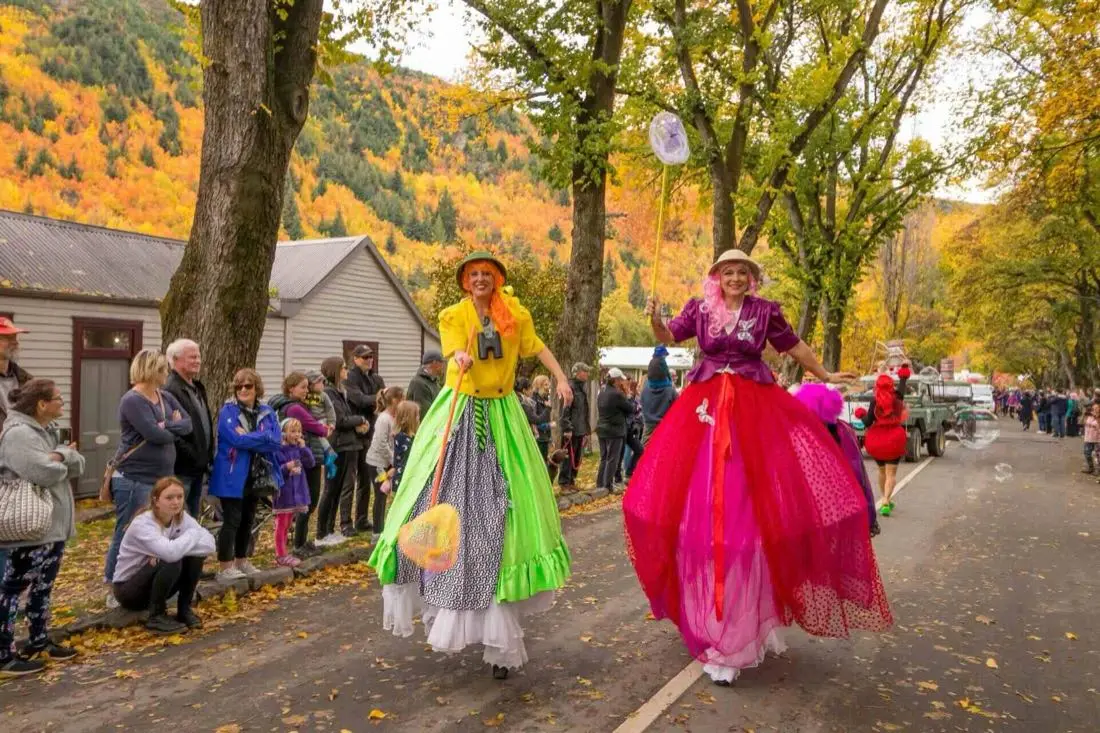
Arrowtown is the best-known autumn destination in New Zealand. The reason is the deciduous trees. Oaks, planes and poplars planted around the town in the gold rush era turn colour through April, concentrated in a way that most New Zealand towns, built around native evergreen bush, simply don’t produce. The colour is heaviest along Buckingham Street and Bush Creek, and it peaks in mid to late April, weather dependent.
The Arrowtown Autumn Festival is on at the same time. It is usually in April with the dates varying slightly. The festival is over 40 years old, with a parade, a market day and food and drink events through the town. It’s a genuinely busy week to visit, so if autumn colour is the goal, book accommodation early.
Walking and cycling around Arrowtown
The Arrow River Bridges Trail is 13.7 kilometres long, between Arrowtown and Gibbston, crossing five bridges including the historic Kawarau suspension bridge. It’s flat, well-formed, and rated an easy grade, which makes it popular with families as well as serious cyclists, and it forms part of the wider 110-kilometre Queenstown Trail network, with Arrowtown as one of its main hubs. You can ride the whole thing, do an out-and-back section, or just walk the first stretch along Bush Creek.
There are shorter walks around the town itself, mostly along Bush Creek and through the surrounding reserve, including a flat walk along the river that suits everyone. Big Hill, Sawpit Gully and Tobins Track all start from the town centre too, and they vary a great deal in difficulty, so check which one you are taking on. Tobins Track is the gentlest of the three. Sawpit Gully is a popular local loop, but it has steep, rough sections and several small water crossings. Big Hill is a serious commitment for both length and steepness.